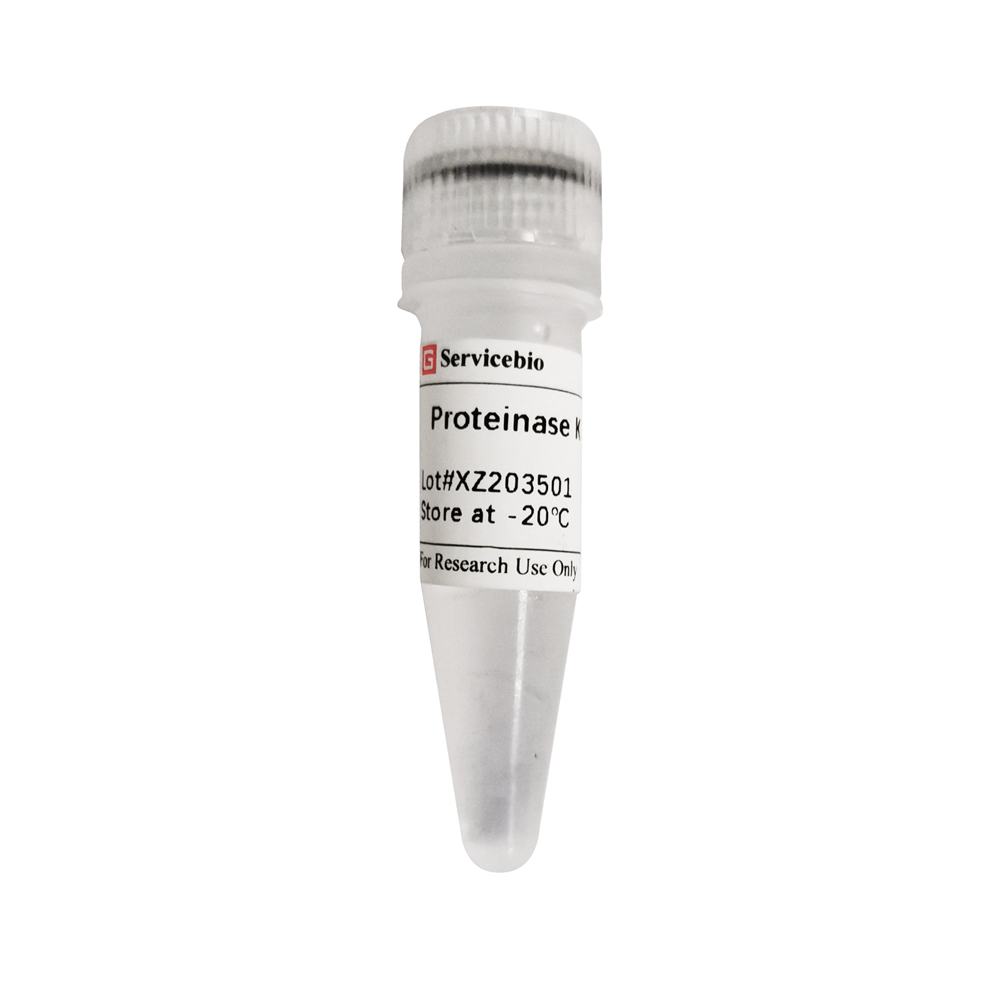
ProductInformation:
Contents | Product number | Size |
Servicebio®Recombinant Proteinase K(20 mg/mL) | G1234-1ML | 1 mL |
Description:
Proteinase K is a broad spectrum protease. Its predominant cleavage site is the peptide bond adjacent to the carboxyl group of aliphatic and aromatic amino acids with blocked α-amino groups. Proteinase K is widely used, commonly used in molecular biology, cell biology, immunohistochemistry and other related experiments to digest various proteins, such as preparing chromosomal DNA for pulse electrophoresis, removing nucleases in DNA and RNA preparation, western blotting, tissue cell permeabilizing and other experiments. Commonly used concentrations of EDTA, Triton X-100, Tween 20, Sarkosyl, and guanidine hydrochloride have little effect on the activity of Proteinase K, while the SDS (1%) can increase its activity. The usual working concentration of Proteinase K is 50-100 µg/mL, and the specific working concentration is determined according to whether the buffer containing the SDS, urea and the pH, temperature of the buffer.
The gene of this recombinant Proteinase K is fromTritirachium album Limber, was mutated by site-directed. Mutant is expressed inPichia pastoris, purified, does not contain DNase, RNase. The molecular weight is about 30kDa. The purity is >95% by SDS-PAGE. This recombinant mutant of Proteinase K has better performance than the wild-type, and it can maintain enzyme activity in a wide pH and temperature range. The effective pH range is pH 7.0-11, with optimal activity at around pH 10. The effective temperature range is 30-65℃. The optimal temperature is 55℃, and 80% of enzyme activity can be maintained at 50℃-60℃, and about 85% of enzyme activity can still be maintained at 65℃. The enzyme will be completely inactivated at 70℃. One unit of enzymatic activity was defined as the amount of proteinase K needed to catalyze the release of 1 μmol of tyrosine per minute at 37℃ and pH 7.5. The specific activity of the Proteinase K produced by our company is >30 U/mg.
Storage:
Store at –20°C for 12 months.
Component:
Component | G1234-1ML |
Proteinase K(20 mg/mL) | 1 mL |
Note:
1. It is recommended to use in separate packaging to avoid repeated freezing and thawing.
2. Due to the high activity and stability of this proteinase K, care should be taken to avoid experimental cross-contamination.
3. For your safety and health, please wear lab coats and disposable gloves for operation.
Description:Proteinase K is a powerful proteolytic enzyme isolated from Candida albicans. It has high specific activity and is a key reagent for DNA extraction. Proteinase K is a stable and highly reactive serine protease. Evidence from crystal and molecular structure studies indicates the enzyme belongs to the subtilisin family with an active-site catalytic triad (Asp39-His69-Ser224). It is stable in a broad range of environments: pH, buffer salts, detergents (SDS), and temperature. In the presence of 0.1-0.5% SDS, proteinase K retains activity and will digest a variety of proteins and nucleases in DNA preparations without compromising the integrity of the isolated DNA.
Product Features:
Proteinase K is a stable and highly reactive serine protease. It cleaves the carboxy terminal peptide bonds of aliphatic amino acids and aromatic amino acids. This enzyme has been purified to remove the activities of RNase and DNase. Because proteinase K is stable in urea and SDS and has the ability to degrade natural proteins, therefore it has a wide range of applications, commonly used in molecular biology, cell biology, immunohistochemistry and other related experiments to digest various proteins, including preparation of chromosomal DNA for pulse electrophoresis, western blotting, and removal of nucleases in DNA and RNA preparation.
Storage Condition:
When stored at –20 °C, the product retains activity for at least 1 years, ice bag transportation.
Instructions:
Can be used in conjunction with our company's TUNEL kit:
Dilute 10 times with PBS (pH 7.4) before usage to prepare proteinase K working solution. Take a certain amount of working solution to cover the tissue, and incubate at 37°C for 10~30 min. Then wash the slides three times with PBS (pH 7.4) in shaker, 5 min each time.
Precautions:
1. It is recommended to use in separate package, avoid repeated freezing and thawing.
2. Due to the high activity and stability of the proteinase K, cross-contamination in the experiment should be avoided.
3. For your safety and health, please wear lab coats and disposable gloves.