


Артикул
G1515-100T
быстрая доставка ~4 недели
Наши менеджеры обязательно свяжутся с вами и уточнят условия заказа
JC-1 Mitochondrial Membrane Potential Detection Kit Cell fluorescent stain Assay Kit
- Описание
-
Product information
product name
Identification of product
model
JC-1 Mitochondrial Membrane Potential Assay Kit
G1515-100T
100T
Descirption/Introduction
JC-1 is a cationic carbonyl cyanine dye, which can pass through the cell membrane and aggregate towards mitochondria under the action of mitochondrial membrane potential. It is an ideal fluorescent probe widely used in detecting mitochondrial membrane potential.When the mitochondrial membrane potential is high, the dye aggregates in the matrix of mitochondria,showing red fluorescence(Ex=585 nm,Em=590 nm);When the mitochondrial membrane potential is low, JC-1 is predominantly a monomer exist in cytoplasm,and showing green fluorescence(Ex=514 nm,Em=529 nm).Therefore, the change of mitochondrial membrane potential can be judged according to the transformation of fluorescence color and the change of proportion, and the decrease of mitochondrial membrane potential is also an important marker of early apoptosis.
JC-1 Mitochondrial Membrane Potential Assay Kit,is based on JC-1 fluorescent probe,which has improved easy precipitation problem and other shortcomings.This kit can be used to quickly and sensitively detect mitochondrial membrane potential changes in cell, tissue or purifiedmitochondria, and is also a common method used to detect early cell apoptosis.
In addition, this kit also provides CCCP (Carbonyl cyanide 3-chlorophenylhydrazone) reagent, a proton carrier (hydrogen ionophore) and decoupler of oxidative phosphorylation in mitochondria, which canpromote changes in the permeability of mitochondria to hydrogen ions , resulting in the decrease or loss of mitochondrial membrane potential, which can be used as a positive control for inducing the decrease of mitochondrial membrane potential.
Storage and Handling Conditions
JC-1 dye(500×)should be stored at -20℃,desiccated and protected from light,and avoid repeated freezing and thawing;
JC-1 buffer and JC-1 diluent may be stored at 4℃.
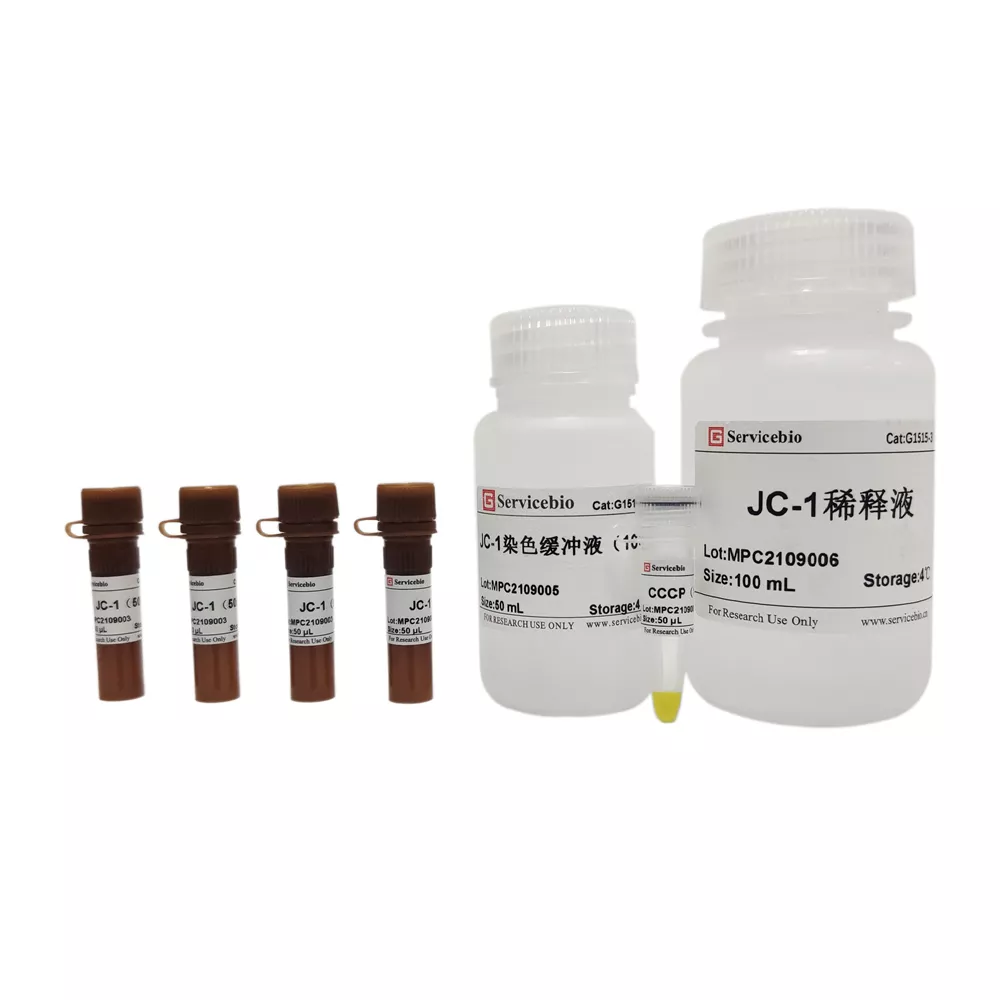
Component
ComponentNumber
Component
G1515-100T
G1515-1
JC-1 dye(500 ×)
4 x 50 μL
G1515-2
JC-1 buffer (10 x)
50 mL
G1515-3
JC-1 diluent
100 mL
G1515-4
CCCP(100 mM)
50 μL
Assay Protocol / Procedures
1.prepare the working solution ofJC-1 dye(2x) and JC-1 buffer(1x):
a. In a suitable container mix 2 μL JC-1 dye(500 ×)to 900 μL JC-1 diluent,then add 100 μL JC-1 buffer (10 x).(Note:this solution should be prepared in order.)
b. In a suitable container diluent the JC-1 buffer (10 x) with ddH2O.
2.prepare a positive control(optional):
a. Take an appropriate amount of CCCP (100 mM) and dilute 1000 times with cell culture medium to obtain 100 μM CCCP working solution;
b. Incubate the cells with CCCP working solution for about 30 minutes, and then follow the JC-1 staining procedure below to detect the mitochondrial membrane potential.
Note: For different cells, the concentration and incubation time of CCCP may be different, please refer to reference or do experiment to find the optimal conditions.
3.Cell stain and analyze
a. Take 100,000 to 600,000 cells, wash cells in JC-1 buffer(1x) or PBS;
b. Add JC-1 dye(2x) and cell culture medium with a ratio of 1:1 to the cells,and incubate in a CO2 incubator for 15-30 min in the dark;
c. Wash cells twice with 1x JC-1 buffer;
d. Analyze on a fluorescence microscope, laser confocal microscope, or flow cytometry.If the cell mainly shows red fluorescence, it indicates that its mitochondrial membrane potential is normal; if the green fluorescence is greatly increased, it indicates that the mitochondrial membrane potential has decreased, and it may be in the early stage of cell apoptosis.
4.Mitochondria stainand analyze
a. Add 100 μL of JC-1 staining working solution to 100 μL of purified mitochondria with a total protein content of 10-100 μg;
b. After mixing, use a fluorescence spectrophotometer (excitation wavelength is 485 nm, emission wavelength is 590 nm) or microplate reader and other instruments for scanning detection (when the excitation wavelength cannot be set to 485 nm, it can be set in the range of 475 ~ 520 nm Excitation wavelength), can also be observed by fluorescence microscope or laser confocal microscope
Note: For the accuracy of the experiment, it is recommended that the samples after JC-1 incubation should be tested within 30 minutes.
This product is for research only, not for clinical diagnosis!


